

The Wrong Scandal
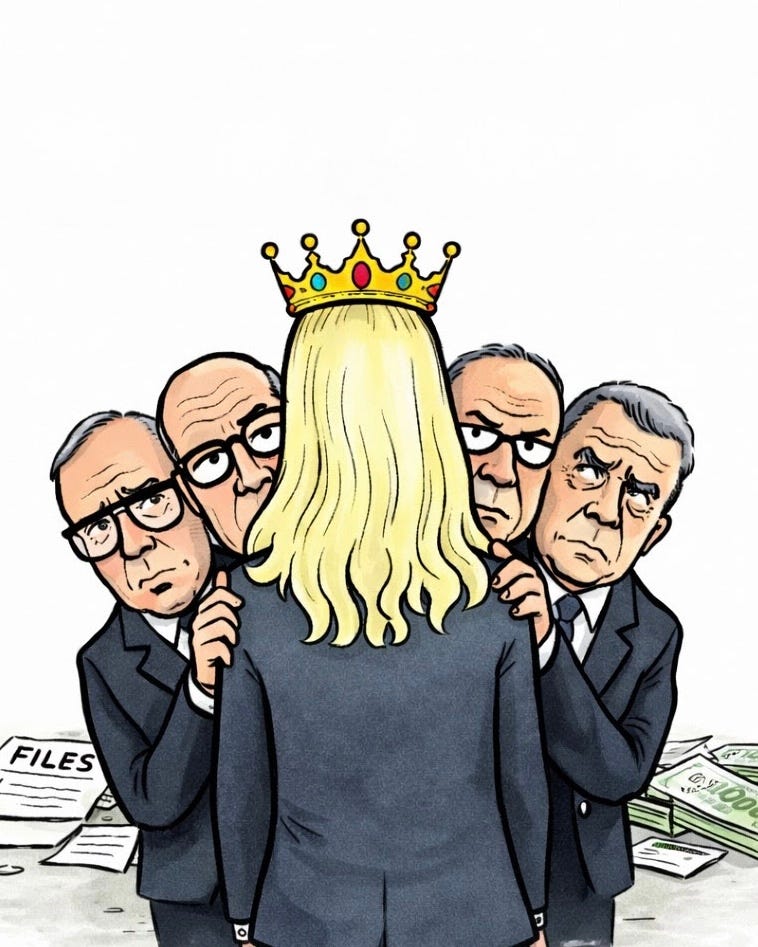
How Norway’s Epstein Crisis Became About a Princess and Not the Men Who Held Power

Sources are cited throughout and readers are encouraged to verify them. The analysis and editorial judgement are my own. All individuals named in connection with ongoing investigations are presumed innocent unless and until a court finds otherwise.
When the Epstein files broke over Norway in early February 2026, the country’s media, and much of the international press that followed, focused its gaze almost entirely on Crown Princess Mette-Marit. Her messages to Epstein were intimate in tone, embarrassing in content, and undeniably revealing about her judgement. She knew about his criminal record. She continued contact. She was photographed with him. She told him she was bored and asked him to come and save her.
None of that is trivial. But it is also not the story.
The actual story, the one that deserves sustained national and European attention, involves a cohort of Norwegian men who collectively occupied some of the most powerful positions in European and global governance over more than two decades, who cultivated a convicted child sex offender, who facilitated access to young women for him, who received money from him, who lied about the relationships until documentary evidence made denial impossible, and whose institutional roles meant that any compromising of their independence had direct consequences not just for Norway, but for the architecture of European diplomacy, the Council of Europe’s human rights mandate, the credibility of UN-mediated peace processes, and the question of whose interests were actually being served.
The Crown Princess had no state power. The men did.
A Note on How to Read This Article
Before proceeding, it is worth being explicit about the three types of claim that follow, because they are not equivalent and should not be read as such.
The first type concerns what the documents establish directly. The “Epstein files” refers to more than three million pages of material released by the US Department of Justice under the Epstein Files Transparency Act, signed into law in November 2025, comprising emails, financial records, flight logs, court exhibits and investigative files from multiple FBI proceedings. Where this article says the documents show something, that claim rests on reporting by major outlets, primarily NRK, Dagens Næringsliv, CNN, Bloomberg and Al Jazeera, that have reviewed those primary materials.
The second type concerns what credible investigative reporting by named outlets has alleged based on sources and testimony. These claims are attributed throughout and should be read as reported allegations, not established facts.
The third type is analytical inference, where this writer draws conclusions from the pattern of documented behaviour. These inferences are flagged as such. Where I state something clearly, readers should be confident it is in the first or second category. Where I raise a question, it belongs to the third.
A Small Country, a Very Large Network
Norway has fewer than six million inhabitants. Its political and diplomatic elite is correspondingly compact. People know each other. Careers interlock. The same Labour Party networks that produced Jagland as Prime Minister also produced Rød-Larsen as a key diplomatic figure, elevated Mona Juul through the foreign ministry, and gave Børge Brende his start, albeit from the Conservative Party. When this many prominent figures from such a small country appear in the files of a convicted sex trafficker, the density of the problem is not a coincidence. It is a structural feature.
Taken individually, each of these episodes could perhaps be explained as poor judgement in a career of genuine achievement. It is the pattern across three decades, and the consistency of the financial logic running through it, that raises the more serious questions.
Terje Rød-Larsen: The Most Serious Case
Legal status as of April 2026: Under formal investigation by Økokrim for corruption and complicity. No charges have been filed. He denies all allegations and has stated he is cooperating with investigators. His lawyer has confirmed he answered questions put to him by Økokrim in detail.
Terje Rød-Larsen is a sociologist who became one of the most influential Norwegian diplomats of the post-Cold War era. As director of the FAFO research institute, he created the back-channel that made the Oslo Accords possible. He served as a UN special coordinator in the Middle East, briefly as Norway’s deputy prime minister in the Jagland government of 1996, and from 2004 to 2020 as president of the International Peace Institute in New York, a think tank located directly adjacent to UN headquarters. He described Epstein as his “best friend” and told him in 2017, in emails published in the DOJ files, that he appreciated everything he had done.
That biography, as conveyed in official accounts and in the 2017 Broadway play that Epstein himself helped finance, is the version Norway chose to tell about itself. The fuller version looks rather different.
Before examining the Epstein relationship, it is worth pausing on a detail that Norwegian commentary has largely glossed over. The Epstein affair was not the first time Rød-Larsen left public office under a cloud of financial impropriety. Nor the second.
In the early 1990s, before his diplomatic fame, Rød-Larsen served as marketing director at a company called Fideco. The company collapsed in bankruptcy, with losses reported to have cost Norwegian taxpayers approximately 80 million kroner, while several local fishermen faced losses running into millions. In the period just before the bankruptcy, Rød-Larsen redeemed a personal share option worth 600,000 kroner in circumstances Økokrim considered questionable. He was fined 50,000 kroner, meaning he retained the bulk of the gain. When Jagland appointed him to the government in 1996 as Deputy Prime Minister and Minister for Planning, the matter resurfaced in the press. He lasted approximately 35 days in the post, widely described by Norwegian media as the shortest ministerial career in Norwegian history, before being forced to resign. He was back in the UN system within three years, appointed by Secretary-General Kofi Annan as personal representative to the PLO and Palestinian Authority.
Then, in 2002, the Israeli right leaked to the press that Rød-Larsen and Mona Juul had each accepted $100,000 from the Peres Center, a body closely connected to the Oslo process with which he had obvious professional ties. This episode is documented in the journal of the Institute for Palestine Studies. Juul was recalled to Oslo by the foreign minister, reprimanded, and required to return the money. Rød-Larsen, by then back at the UN and beyond the direct reach of Norwegian political accountability, said publicly that he deserved the payment and kept it.
Three separate episodes over three decades: Fideco, the Peres Center, and then Epstein. The pattern is not of occasional lapses in judgement. It is of a man who consistently treated financial benefit and institutional position as interchangeable, who faced minimal consequences each time, and who was consistently rehabilitated by the same networks that had the most to gain from his connections and reputation. The Norwegian system did not miss the warning signs. It absorbed them.
The documentary record now assembled by Økokrim, NRK and Dagens Næringsliv reveals an Epstein relationship that goes considerably further than friendship.
According to NRK and Al Jazeera reporting based on the released files, Rød-Larsen wrote official letters of recommendation to US immigration authorities on behalf of young Russian and Eastern European women in Epstein’s orbit, falsely representing them as possessing “extraordinary abilities” appropriate to academic research positions. The women were, in reality, models with no academic credentials. In accounts given to NRK, two women described their experiences: one said she believed Epstein had sent her to Rød-Larsen’s institute specifically to manipulate her; another described how Rød-Larsen facilitated her visa after a direct request from Epstein’s assistant. The lawyer representing one of the women who spoke to NRK stated explicitly that the IPI and Rød-Larsen were not involved in sexual offences against her client. No court has determined the full nature of Rød-Larsen’s role, and the investigation is ongoing.
What the documents do establish, on the basis of reporting by NRK and others, is that Rød-Larsen wrote those letters, that the women who received the visas describe a connection to their subsequent abuse, and that he did so as president of a UN-adjacent institution, using its letterhead, for a man he knew to be a convicted sex offender. That is documented facilitation. What it constitutes legally is for the investigation and, if charges follow, a court to determine.
Norwegian authorities had already communicated concerns about this to the FBI in 2019. According to NRK reporting, Norwegian prosecutorial authorities alerted US investigators to concerns about young Eastern European women receiving short internships at the IPI, and about their photographs being shared with Epstein. That communication was made seven years before the current crisis. It is not publicly known whether any Norwegian domestic action followed, and that absence of public knowledge is itself a question the commission must address.
The financial dimension is documented in the files. Epstein loaned Rød-Larsen $130,000 in 2013, as first reported by Dagens Næringsliv. Epstein’s signed will, dated two days before his death and reported by Bloomberg, Al Jazeera and others citing probate documents, contained a clause bequeathing five million dollars to each of Rød-Larsen’s two children. Whether those bequests can ever be executed remains subject to the complex legal proceedings surrounding Epstein’s estate, but the intention is documented. Bloomberg’s February 2026 headline described Rød-Larsen as “Epstein’s Top Diplomatic Fixer,” a headline characterisation that the documentary record appears to support.
There is a further dimension that has received very little mainstream coverage. A shipowner named Morits Skaugen has publicly stated that he was coerced into selling a large Frogner apartment, at half its market value, to Rød-Larsen and Mona Juul. According to Skaugen’s account, Epstein acted as intermediary, displayed photographs of himself alongside the chairman of the bank from which Skaugen’s company had borrowed, together with a detailed map of his business connections, and threatened to dismiss a relative of Skaugen’s from the IPI. Skaugen described these tactics as “mafia methods.” Neither Rød-Larsen nor Juul have publicly responded to these specific allegations, beyond their lawyers’ general denials of all corruption charges. Skaugen’s account has not been tested in court. If accurate, it describes the use of intelligence-style leverage in a real estate transaction that directly benefited serving Norwegian diplomats, which would be a matter of considerable additional seriousness.
One further thread deserves attention, because it has received almost no sustained coverage in Norwegian mainstream media. The Epstein files contain a photograph showing Steve Bannon, Terje Rød-Larsen and Børge Brende together at Epstein’s Manhattan home. According to Aftenposten’s February 2026 reporting on the files, the photograph was sent by Epstein directly to Brende, establishing its authenticity and confirming that Brende received it. It was taken in April 2018. Rød-Larsen, a lifelong Labour politician by origin, appears in this image alongside the principal architect of the American populist right, in the home of a convicted sex offender, together with Norway’s then-WEF-bound former Foreign Minister. Aftenposten described Rød-Larsen as the central node in Epstein’s Norwegian network. The ideological range of the company Rød-Larsen kept within that network, spanning Norwegian social democracy, the UN system and the international populist right, is a thread that Norwegian media have not investigated in any depth.
Thorbjørn Jagland: The Corruption of Europe’s Human Rights Guardian
Legal status as of April 2026: Formally charged with aggravated corruption, the Norwegian legal term “grov korrupsjon,” by Økokrim in February 2026, following the waiver of his diplomatic immunity by the Council of Europe’s Committee of Ministers at Norway’s request. He denies all charges and states he is cooperating with the investigation. He was hospitalised in late February 2026 under circumstances widely reported by Norwegian and international media as a suicide attempt.
If Rød-Larsen represents the most operationally serious case, Thorbjørn Jagland represents the most institutionally catastrophic one. As Secretary-General of the Council of Europe from 2009 to 2019, he was the formal guardian of the European Convention on Human Rights, the continent’s foundational legal framework for the protection of fundamental rights. He maintained a close personal relationship with Epstein throughout that entire decade, commencing after Epstein’s 2008 conviction for soliciting a minor for prostitution in Florida.
He stayed at Epstein’s Paris apartment. He received hospitality from Epstein. He also chaired the Norwegian Nobel Committee throughout most of this period. In 2019, following Epstein’s death and the initial exposure of his networks, the Committee chair asked each member directly whether they had been in contact with Epstein. Jagland gave a response. The following year, according to reporting by multiple Norwegian outlets including NRK, he gave a different one. The precise wording of both exchanges is not publicly available in verbatim form, and this writer is drawing on Norwegian media accounts of the sequence. Whatever the exact phrasing, the reported sequence means that the chair of the body that awards the Nobel Peace Prize gave inaccurate information to his own committee about his relationship with a convicted sex offender.
The emails in the DOJ files, reported in detail by CNN citing the primary documents, add a dimension that goes well beyond personal embarrassment. They show Jagland meeting Putin four times in official Council of Europe delegation between 2011 and 2018, which is confirmed by Kremlin records. During the same period, the files show him offering to use those access points to facilitate Epstein’s approach to the Russian leadership. In May 2013, he wrote to Epstein that he planned to pass a message to Putin that Epstein was a useful contact. In a separate email, he wrote: “You can tell him that you and I are close, and that I advise Gates.” In June 2018, he emailed Epstein to arrange to stay at his Paris residence, noting he was travelling from Moscow where he planned to meet Putin, Lavrov and Medvedev. The email includes the line “I promise not make noice or ruin you,” with the spelling and register of the language suggesting a relationship of considerable intimacy. He also communicated that Epstein could tell Putin that Lavrov “can get insight on talking to me.” These quotations are drawn from CNN’s primary reporting on the DOJ files.
The distinction worth drawing here is between access facilitation and proven influence. What the documents establish is that Jagland offered to act as a conduit between Epstein and Russian leadership. Whether Epstein ever gained any meaningful access through that conduit, and whether any policy or diplomatic outcome was affected, is not established by the emails alone. The significance lies in the offer itself: the Secretary-General of the Council of Europe was attempting to serve as an introduction broker for a convicted sex trafficker to the President of Russia, while simultaneously holding the most senior human rights position in European institutional life.
Sources in the Caspian region, drawing on longer-standing intelligence reporting, have further alleged that Jagland’s conduct within the Council of Europe was broadly consistent with functioning as a Russian influence asset, notably his campaign to restore Russian voting rights in the Parliamentary Assembly after the annexation of Crimea, and his reported efforts to weaken the Council’s relationship with Azerbaijan. These claims are contested, have not been proven in any formal proceeding, and should be treated with appropriate caution. They are, however, not claims invented in response to the Epstein files, and Norwegian and European diplomatic circles are reported to have been uncomfortable with aspects of Jagland’s institutional conduct well before 2026. The commission of inquiry should examine this dimension.
Jagland’s diplomatic immunity, which covered his official conduct as Council of Europe Secretary-General, remained in place throughout the period under investigation. It was waived only in February 2026, at Norway’s request. The investigation must now determine what, if anything, the Council of Europe’s own oversight mechanisms knew or should have known during his decade in office.
Børge Brende: The Evasive Denial
Legal status as of April 2026: Not under criminal investigation. Resigned from the WEF presidency in February 2026. An independent WEF review, conducted by outside counsel, concluded there were no concerns beyond those already publicly disclosed.
Børge Brende served as Norway’s Foreign Minister from 2013 to 2017, then became president and CEO of the World Economic Forum. In November 2025, as an earlier tranche of the Epstein files was generating international scrutiny, Aftenposten confronted Brende with questions about whether he had been asked to meet Epstein in Geneva. In a written response dated 20 November 2025, Brende stated: “Jeg har aldri hatt noe med Epstein å gjøre og jeg har aldri møtt ham i Genève,” that is: “I have never had anything to do with Epstein and I have never met him in Geneva.” Aftenposten published this denial on 4 February 2026, under the headline “Børge Brende for to måneder siden: «Jeg har ikke hatt noe med Epstein å gjøre»,” at the moment the January 2026 files release made the denial impossible to sustain. The statement was both categorical, a blanket disavowal of any connection, and specific, a direct denial of the Geneva meeting.
The larger DOJ files release in January 2026 showed that Brende had met Epstein at least three times for dinner between 2018 and 2019 and had corresponded with him on multiple occasions. He was introduced to Epstein by Rød-Larsen. According to Epstein files material reported by Norwegian media, on 13 January 2019, the same day the WEF signed a formal cooperation agreement with the United Nations at a ceremony in which Brende participated alongside WEF founder Klaus Schwab and UN Secretary-General António Guterres, Brende visited Epstein. Schwab’s spokesman subsequently told Norwegian press that Schwab would never have tolerated such contact and had not been informed of it. Schwab also reportedly considered legal action against Brende over his public claims.
The files also show Brende entertaining, in communications with Epstein, the idea that the World Economic Forum could eventually replace the United Nations. Brende has said these messages are taken out of context and that his statements were casual rather than reflective of any policy intention. That explanation is on record. What the episode illustrates, regardless of intent, is that a former Foreign Minister of Norway was discussing the restructuring of global governance architecture in private communications with a convicted sex offender.
Brende’s written statement to Aftenposten in November 2025, in which he categorically denied ever having had anything to do with Epstein and denied a specific Geneva meeting, was contradicted in its entirety by the documentary record the following January. The files showed not one but multiple meetings, sustained correspondence, and a visit to Epstein’s home on the same day as a major WEF-UN signing ceremony. Brende subsequently attributed his November statement to having failed to recall the encounters and to ignorance of Epstein’s background. That explanation sits uneasily alongside the Aftenposten photograph showing him at Epstein’s Manhattan home, which Epstein himself sent to Brende, and alongside the breadth and specificity of the denial he gave. Whether his response constituted a deliberate misrepresentation or a calculated narrowing of the question is a distinction the reader may draw. He resigned from the WEF on 26 February 2026.
Mona Juul: The Ambassador in the Network
Legal status as of April 2026: Under investigation by Økokrim for corruption, according to Newsinenglish.no reporting and Økokrim’s published statements. No charges have been filed. She resigned as Norway’s ambassador to Jordan and Iraq in February 2026. The Norwegian Foreign Ministry revoked her security clearance, according to Foreign Ministry statements reported by Norwegian media. She denies wrongdoing and states her contacts with Epstein arose through her husband’s relationship with him.
Mona Juul’s involvement was, on the available evidence, less directly operational than her husband’s. But her position requires attention. She was a senior Norwegian diplomat throughout the period in question, serving as ambassador to several countries and, at the time of her suspension, as ambassador to Jordan and Iraq. Her children were named as beneficiaries in Epstein’s will alongside their father’s. Her security clearance was revoked before her resignation, which the Foreign Ministry confirmed, and which is itself a significant formal step.
A 2014 email in the files shows a dinner invitation from Juul and Rød-Larsen being routed through Epstein, passed to filmmaker Woody Allen and his wife Soon-Yi Previn. The social world this couple occupied with Epstein’s active facilitation, and what Norwegian diplomatic prestige and access were offered or exchanged within it, are questions the commission will need to examine.
Who Knew, and When?
This is the question that Norwegian public debate has not pursued with sufficient force, and it is the question the Storting’s commission of inquiry must answer if Norway is to achieve genuine accountability rather than a managed institutional process.
The available evidence suggests that what these men were doing was not entirely unknown in the relevant circles. Norwegian prosecutorial authorities communicated specific concerns about Rød-Larsen’s institute and its young women to the FBI in 2019, seven years before the current crisis. Whether any Norwegian domestic action followed is not publicly known, and that absence of public knowledge is itself part of the problem this article is identifying. What did PST, Norway’s domestic security service, know about the sustained contacts between Norway’s most senior diplomatic figures and a convicted sex offender? What did the Foreign Ministry know about Rød-Larsen’s private archive of the Oslo negotiations, now known to be missing key documents? What did the Labour Party leadership know about Jagland’s relationship with Epstein during the years when he simultaneously chaired the Nobel Committee and led the Council of Europe? What did the Conservative Party leadership know about Brende’s Epstein contacts when he was serving as their Foreign Minister?
A crisis communication scholar at the University of Oslo, cited by Courthouse News Service, put the pattern precisely: the Norwegian actors “have not been honest about either the intensity or the intimacy of their Epstein contacts. My guess is that they thought it would never come out.”
That formulation is accurate as far as it goes, but it understates the structural problem. Politicians and diplomats who maintain financial relationships with convicted sex offenders while holding positions of state power do not simply make errors of social judgement. They create conditions under which they can be compromised. They open their official positions, and by extension their countries’ diplomatic interests, to pressure from those who hold leverage over them. Skaugen’s account, if accurate, illustrates precisely this mechanism. Whether or not that mechanism was ever used to affect Norwegian policy decisions is something only the commission, with access to classified intelligence reporting and the PST archive, is in a position to determine.
The Oslo Accords: A Peace Built on Compromised Foundations?
What follows moves from documented evidence into contested historical and political territory. These are distinct categories and should be read accordingly. This section connects the documented Epstein material to longer-standing historical questions that predate the files and cannot be resolved by them alone.
The Oslo Accords of 1993 and 1995, brokered with Rød-Larsen as the central Norwegian facilitator, are widely regarded as the defining achievement of Norwegian diplomacy. A play about them was produced in 2017, financed in part by Jeffrey Epstein. A film was made by Steven Spielberg in 2021. Norway’s self-image as a “humanitarian great power” and honest peace broker rested substantially on this foundation.
Norwegian historian Hilde Henriksen Waage, described as Norway’s leading academic authority on the negotiations, has argued on the basis of archival research that the Oslo process was conducted on Israel’s terms, with Norway playing a facilitating role that served Israeli rather than Palestinian interests. This assessment long predates the Epstein files and is contested within the scholarly community. There are serious researchers who argue that the Accords represented the best achievable outcome for the Palestinians at the time, given the PLO’s acute political and financial weakness, and that the failure of the peace process should be attributed primarily to Israeli settlement expansion and the collapse of final-status talks after 2000 rather than to any deficiency in the mediation. Both assessments are represented in the academic literature and deserve to be read on their own terms.
What the Epstein files add is a distinct and newer question, separate from the historical debate about Oslo’s terms: the integrity of the mediator himself. Key documents from the period between January and September 1993, covering the critical months of the secret negotiations, are absent from the Norwegian Foreign Ministry archive. This is established by media investigations cited in the Institute for Palestine Studies journal, which notes that the archive gap was identified years before the Epstein revelations and that the Norwegian Foreign Ministry at one point apparently accepted Rød-Larsen’s claim that no relevant documents were in his possession. Those documents appear to be in the private archive he maintained personally and has never made available to the state. Palestinian politicians, including Mustafa Barghouti of the Palestinian National Initiative, argue that Rød-Larsen’s subsequent financial entanglement with Epstein, and Epstein’s documented ties to figures including former Israeli Prime Minister Ehud Barak, who is documented in the files as a close Epstein contact, raise the question of whether the mediation was compromised. Barghouti’s argument should be understood as a political allegation advanced from a partisan position, not as an evidentiary conclusion.
A question that is sometimes raised in connection with all of this is what might seem like a contradiction. If the Accords were structured to serve Israeli interests, why did enormous sums of international money simultaneously flow to Arafat, the PLO and the Palestinian Authority? Does that donor funding not suggest genuine international commitment to Palestinian state-building?
The apparent contradiction dissolves when you consider the structural logic. By 1993, the PLO was financially desperate. It had alienated its Gulf funders by supporting Iraq during the Gulf War, and Arafat faced serious internal challenges from Hamas and groups gaining influence during the intifada. He entered the Oslo negotiations from a position of weakness and financial need. What Oslo gave the PLO leadership, in exchange for setting aside the core Palestinian demands on settlements, Jerusalem, borders and refugees, was institutional legitimacy, a physical return to the territory, and access to the international donor pipeline. From 1994 onwards, international institutions subsidised the Palestinian Authority to the tune of billions of dollars, the EU being the major contributor, with Norwegian bilateral aid as part of that flow.
The key point is that this money did not contradict an agreement favourable to Israel. It functioned to sustain one. Arafat and his inner circle gained personal financial security and institutional power in exchange for accepting terms that left Israeli settlement construction unchecked. Suha Arafat is reported to have lived in Paris on $100,000 a month from the Palestinian Authority budget. French prosecutors opened an investigation into the transfer of over $11 million into her Swiss-linked accounts. Former Israeli Foreign Minister Shlomo Ben-Ami wrote, in his account of the period, that Oslo effectively made the PLO a collaborator in ending an authentically democratic Palestinian struggle. The donor money flowing to PLO figures was simultaneously the reward for accepting Oslo’s terms and the mechanism that kept a sufficiently compliant leadership in place.
Whether Rød-Larsen understood and shaped this system, or was embedded within it as a well-connected facilitator, is something the commission should consider seriously. The missing documents are directly relevant. This article cannot answer that question, and will not claim to.
The Wider European Picture: Norway Is Not Alone
Any Norwegian account of this scandal must place it in European context, because the pattern is not specifically Norwegian. It is a feature of a wider institutional culture.
In the United Kingdom, Peter Mandelson, former Labour minister, EU trade commissioner and, until recently, British ambassador to the United States, was arrested and questioned by police over allegations that he passed market-sensitive government information to Epstein while serving as Business Secretary during the 2008 financial crisis. He had referred to Epstein as his “best pal” in a 2003 written message. His relationship with Epstein continued after the 2008 conviction. Prime Minister Keir Starmer appointed him as ambassador to Washington in late 2024. Starmer has since apologised to Epstein’s victims. The circumstances of that appointment and its consequences have become a significant political crisis for the British government. Mandelson has been arrested and questioned but not charged as of the time of this writing.
Andrew Mountbatten-Windsor, formerly Prince Andrew and now stripped of his royal titles, was arrested and questioned over allegations of misconduct in public office related to leaking sensitive information during his time as a British trade envoy. This is a legally distinct matter from the longstanding and separately proceeding allegations of sexual misconduct connected to his friendship with Epstein and Ghislaine Maxwell. His arrest for questioning was described by multiple British outlets as the first detention of a senior British royal in living memory. He has not been charged.
In France, Jack Lang, a celebrated figure of French cultural and political life who served as culture minister and education minister across nearly two decades under Mitterrand and Hollande, resigned from the presidency of the Arab World Institute after his name appeared, according to Reuters, more than six hundred times in the Epstein files dataset. A mention in that dataset does not by itself indicate wrongdoing, as French and Norwegian authorities have both noted publicly, but the frequency and the nature of the communications prompted French prosecutors to open a formal investigation. Separately, Fabrice Aidan, a French diplomat who served for eight years as special assistant to Rød-Larsen at the UN, is under investigation by French authorities. His lawyer has categorically denied the allegations against him. Aidan appears in the files as the operational conduit through which Epstein was first introduced into the UN diplomatic network around Rød-Larsen, from 2010 onwards. According to reporting by France 24 and the French investigative outlet Mediapart, he was investigated by the FBI in 2013 over alleged access to child sex abuse websites while employed at the UN. No charges were brought, a fact his lawyer has emphasised. The French Foreign Ministry has referred his case to the Paris public prosecutor and launched an internal disciplinary investigation. Engie, his former private sector employer, dismissed him. The Aidan case matters directly for the Norwegian story because he was Rød-Larsen’s direct professional subordinate for nearly a decade, and the channel through which Epstein entered the UN-linked institutional world that Rød-Larsen dominated.
In Slovakia, Miroslav Lajčák, former president of the UN General Assembly and national security adviser to Prime Minister Fico, resigned after the release of messages between him and Epstein discussing women in terms that Lajčák himself described, on Slovak public radio, as “stupid male egos in action.” In Sweden, Joanna Rubinstein, chair of Sweden for UNHCR, resigned after her 2012 visit to Epstein’s Caribbean island became public.
The pattern across these cases shares important structural features. Men in senior positions of public trust who continued contact with Epstein after his 2008 conviction, who received benefits from him or facilitated his access, and who then understated or denied those relationships until documentary evidence made that impossible. The European institutions these men moved within, the Council of Europe, the UN system, the WEF, national foreign ministries, provided both the access that made them valuable to Epstein and the protective structures that insulated them from scrutiny for years.
The contrast with the United States deserves careful handling. In Europe, consequences have followed exposure: arrests for questioning, resignations, criminal investigations, immunity waivers, security clearance withdrawals. In the United States, prominent figures with documented Epstein ties, including the sitting President, have faced no comparable accountability. This European willingness to apply consequences is genuine and should be acknowledged. It is also incomplete, in that the systemic conditions that allowed these networks to operate for years within European institutions remain largely unexamined and unreformed.
The Blackmail Dimension: Between Evidence and Speculation
Underlying the entire Norwegian story, and the wider European one, is a question that serious journalism cannot avoid but must handle with precision: was Epstein simply a well-connected predator, or was he something more structured than that?
The Epstein files contain documentary evidence that Epstein installed hidden cameras in his properties. An email from Epstein to a staff member, published in the DOJ files and reported by multiple outlets, directed the installation of motion-sensitive cameras concealed in ordinary household objects. An investigator cited in subsequent reporting described the surveillance system as “systematic” and said the layout was consistent with an intent to record private moments. This is reported documentary evidence, not speculation, though the investigator’s characterisation of intent should be read as an assessment rather than a legal determination.
Skaugen’s account of Epstein displaying what appeared to be detailed financial intelligence about his banking relationships and business connections is consistent with the methods of a structured information-gathering operation, whatever its ultimate purpose. Taken together, the surveillance infrastructure and the alleged use of financial dossiers for coercion are consistent with, though not proven to constitute, a systematic blackmail operation.
What remains genuinely speculative is whether Epstein was operating as an asset of one or more state intelligence services. The files confirm his ties to figures with documented connections to Israeli intelligence, including Ehud Barak, a former Prime Minister who also served as head of military intelligence. They document his financial support for Israeli organisations. They also document sustained contact with FSB-connected Russian figures and his efforts, through Jagland among others, to gain access to Russian leadership. Polish Prime Minister Donald Tusk announced a formal investigation into possible Epstein links to Russian intelligence, according to Euronews reporting from March 2026, though the current status of that investigation at the time of publication is not confirmed.
The honest analytical position is this: Epstein’s documented behaviour, building a network of elite contacts through financial entanglement, using concealed cameras to record private moments, apparently maintaining financial intelligence on individuals in his network, is structurally consistent with a state-run honey-trap operation. Whether it was run in concert with a state actor, or was an independent private operation that various intelligence services subsequently sought to exploit or monitor, is a question neither the available documents nor the ongoing investigations have answered. Anyone who asserts certainty in either direction is going beyond what the evidence supports.
This unresolved question is precisely the space in which conspiracy theories flourish. The appropriate response is not to dismiss it, but to support the investigations that might eventually answer it.
Why the Princess Dominates the Coverage, and Why That Is a Structural Problem
The media dynamics of this story deserve a brief examination, because they are part of the problem.
Crown Princess Mette-Marit is legible to the public in a way that institutional corruption is not. She is known. She has a complicated personal history. Her son Marius Borg Høiby is simultaneously on trial facing serious charges of his own. She is a woman in a network where the structural wrongdoers are men, providing a culturally familiar narrative of female recklessness surrounded by male corruption. And the royal house, unlike Jagland or Rød-Larsen, cannot invoke active legal proceedings, lawyer-mediated silences, or the complexity of diplomatic immunity to manage what is said about it.
There is also a structural dimension that rarely gets mentioned. The commission of inquiry established by the Storting cannot, by constitutional design, investigate the Crown Princess. Parliament lacks jurisdiction over the royal house in this way. The paradoxical result is that the figure whose conduct was least consequential in governance terms is the one about whom public debate is least constrained, while the figures whose conduct was most consequential are shielded by legal process and institutional opacity.
This is not an argument that Mette-Marit deserves to escape scrutiny. It is an argument that the media ecosystem’s sustained focus on her is, functionally, a distraction from the men whose official roles are the subject of criminal investigation. And it is an observation that this distraction is, in one sense, convenient for the political establishment that produced and repeatedly rehabilitated those men.
What the Commission Must Ask
The Norwegian commission of inquiry, established by the Storting’s Standing Committee on Scrutiny and Constitutional Affairs in February 2026, has a mandate extending back before 1993, tasked with examining how Norwegian institutions, public funds and public roles interacted with Epstein’s network. It has a genuinely historic opportunity, and the following questions are the ones it must pursue.
What did Norway’s security and intelligence apparatus, PST, the Foreign Ministry, and the relevant government ministries, know about the sustained relationships between Rød-Larsen, Jagland, Brende and Epstein, and when did they know it? If they did not know, why not, given that Norwegian prosecutorial authorities had communicated specific concerns about Rød-Larsen’s institute to the FBI in 2019?
What is in Rød-Larsen’s private archive of the 1993 Oslo negotiations, and why are documents from the critical January to September 1993 period absent from the official Foreign Ministry record? Who decided, in 2007, that the Foreign Ministry had received all relevant material, and on what basis?
How was Jagland able to serve as Council of Europe Secretary-General for ten years, receiving financial benefits from and staying in the properties of a convicted sex offender, without any oversight mechanism, either within the Council or in the Norwegian government, triggering a review?
What was the full scope of Norwegian public funds that flowed through institutions in which these figures were centrally involved, including the IPI and the Norwegian foreign aid apparatus more broadly, and is there evidence of diversion or inappropriate use?
What is the current status of the photographs that Norwegian authorities described, in their 2019 communication with the FBI, as being taken of young women at the IPI and shared with Epstein?
And, most fundamentally: what does Norway owe to the victims of this network? Not the politicians and diplomats who are embarrassed or under investigation, but the young women from Eastern Europe who were brought to New York on fraudulent research visas, who describe experiences of abuse, and who have in some cases had the courage to speak publicly to NRK?
The Deeper Question: Who Is Europe Governed By?
The Epstein scandal, viewed from a European perspective, raises a question that goes beyond Norway and beyond individual wrongdoing. It is the question of the governance gap between the people who formally hold democratic mandates and the people who actually shape decisions at the intersection of money, intelligence and international institutions.
The International Peace Institute, the World Economic Forum, the Council of Europe, the UN system: these are not democratically elected bodies. They operate in a space between states, beyond the reach of ordinary parliamentary accountability, staffed by figures who move between them and national governments in ways that insulate them from the electoral consequences that discipline ordinary politicians. The accountability failure this article describes is not primarily one of individual moral weakness, though that is present too. It is one of institutional design: the absence of any mechanism capable of monitoring the private financial relationships of people who hold enormous informal power within bodies that are themselves insufficiently transparent.
Epstein understood this space with unusual precision. He concentrated his network within it, cultivating people who were powerful but unaccountable, status-conscious but insecure, embedded in institutions that projected moral authority while operating with very limited transparency. Whether he did so independently, or as an instrument of something larger, is unresolved. What is not unresolved is that the space he exploited remains largely unreformed.
This is not a Norwegian problem. It is a European governance problem. It will not be solved by the resignation of a WEF chief, the hospitalisation of a former Prime Minister, or the public embarrassment of a Crown Princess. It will only begin to be addressed when the accountability mechanisms that constrain national politicians are extended, seriously and structurally, to the international institutional space in which a significant share of Europe’s real decisions are made.
Norway, precisely because it has been hit harder by this than any other comparable country, is in a position to lead that argument. The commission of inquiry is a beginning. Whether it becomes a genuine reckoning, or a bounded institutional exercise that protects the network it nominally investigates, will depend on political will that has not yet been demonstrated.
What Evidence Would Change This Analysis
Intellectual honesty requires stating what would challenge the central argument of this article, that Norway’s Epstein exposure reflects a structural governance failure rather than a collection of individual misjudgements.
The argument would be significantly weakened if it emerged that the 2019 Norwegian FBI communication was an isolated, low-level alert that produced no actionable intelligence and was appropriately handled. It would be further weakened if Rød-Larsen’s private Oslo archive, when made available, showed no material omissions from the official record. It would be challenged if the Jagland email exchanges, read in full context, proved less significant than the excerpts published so far suggest. And it would be substantially undermined if the Skaugen allegations were demonstrated to be false or significantly distorted.
These are questions the commission of inquiry is positioned to answer. Until it does, the documented pattern across three decades and four individuals demands an explanation that goes beyond bad luck.
A Note on Sources, Method and What Remains Unknown
The “Epstein files” in this article refers to material released by the US Department of Justice under the Epstein Files Transparency Act, comprising emails, financial records, flight logs, court exhibits and investigative records from multiple FBI proceedings.
This article draws on reporting by NRK, Dagens Næringsliv, Aftenposten, Al Jazeera, Bloomberg, CNN, Middle East Eye, the Hill, Courthouse News Service, Euronews, the Globe and Mail, NPR, France 24, the Institute for Palestine Studies, and the French Foreign Ministry’s published statement on Fabrice Aidan. The Jagland-Putin email content is drawn from CNN’s primary reporting on the DOJ files. The Fideco and Peres Center episodes are documented in Norwegian press coverage and the Institute for Palestine Studies journal. The hidden camera email is reported by multiple outlets as appearing in the DOJ files.
Several claims circulating in lower-quality online media and in regional publications with evident political agendas have been excluded because they cannot be verified against primary sources. The Epstein story is a genuine magnet for conspiracy theory. The responsible approach is to distinguish carefully between what the documents establish, what credible investigative reporting has reported, what named individuals allege, and what this writer infers.
Key questions unanswered at the time of publication include: the full content of Rød-Larsen’s private Oslo archive; the outcome of ongoing Økokrim investigations into Rød-Larsen, Juul and Jagland; whether additional Norwegian or European figures will emerge from continued analysis of the files; the current legal status of Epstein’s estate and whether any named bequests could be executed; and the current status of the Tusk investigation into Russian intelligence links. This article will be updated as material develops.
Readers who wish to verify specific claims should consult the primary Norwegian reporting by NRK and Dagens Næringsliv, Aftenposten’s 4 February and 6 February 2026 coverage including the Brende denial and the Epstein-sent photograph from Manhattan, CNN’s February 2026 reporting on the DOJ files and the Jagland-Putin emails, Bloomberg’s 18 February profile of Rød-Larsen, Al Jazeera’s 12 February feature on the Oslo Accords dimension, the French Foreign Ministry’s March 2026 published statement on Fabrice Aidan, and the Institute for Palestine Studies journal article on the Oslo archive.
This article was researched and drafted in collaboration with Claude (Anthropic). As with all articles in this series, the use of AI as a research and drafting partner is disclosed transparently. The analysis, editorial judgement and responsibility for the content are my own.
boergenjaa.substack.com