

When Democracy Says No
Who gets the last word in a democracy?

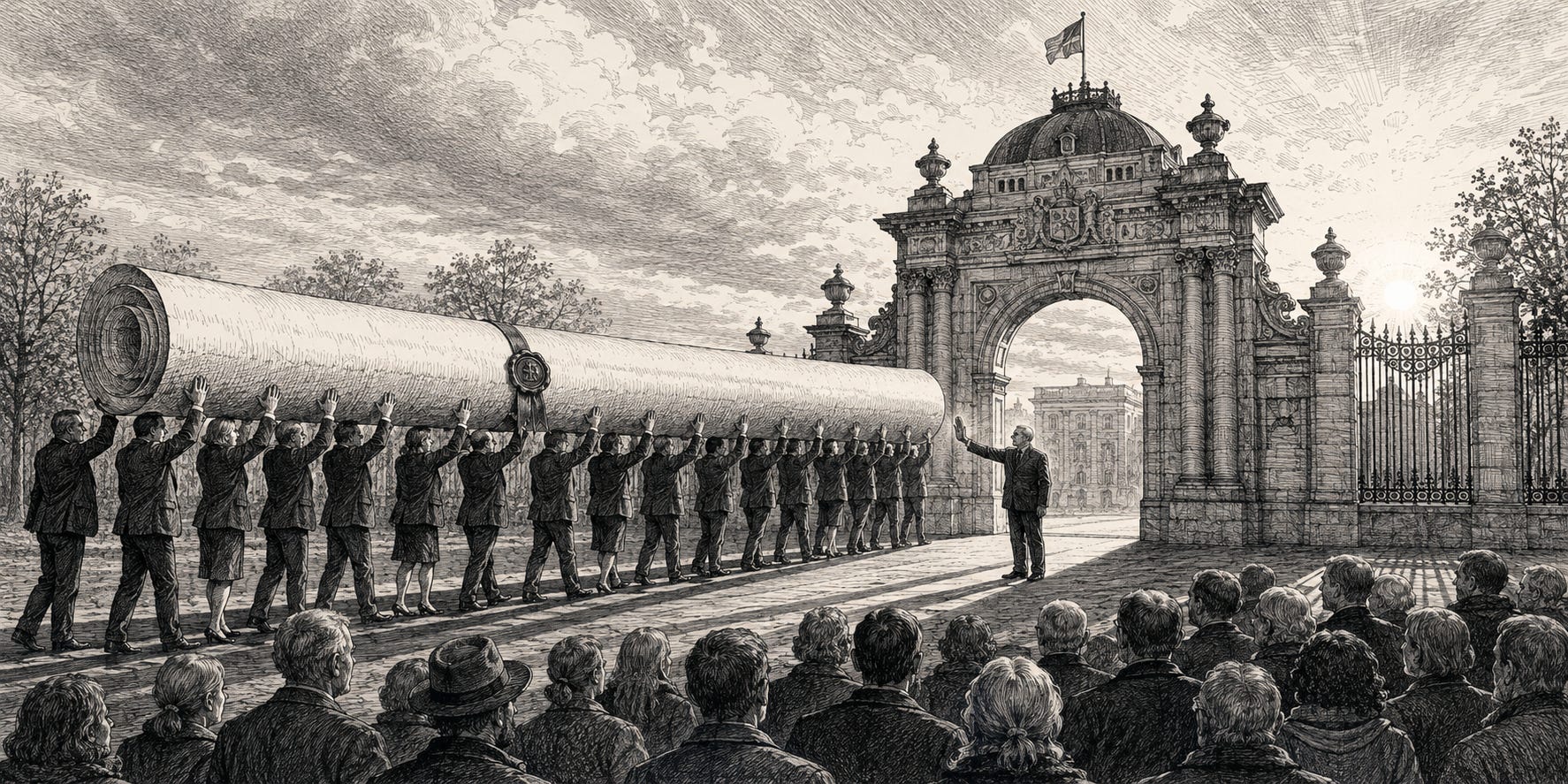
A cohabitation killed by cohabitation
On Friday last week, the president of Poland vetoed a bill that had passed both chambers of parliament, together with its implementing act. The legislation would have allowed two adults, regardless of gender, to sign a cohabitation agreement before a notary, regulating practical matters such as joint property, access to medical information and the right to arrange a partner’s burial. It deliberately excluded adoption and touched nothing in the law of marriage; campaigners described it as a fragment of the civil partnership proposal it began as. Even so, it was the first domestic partnership legislation ever to clear both chambers of the Polish parliament. President Karol Nawrocki announced that, as guardian of the Constitution, he could not accept what he called a backdoor introduction of civil partnerships that would supplant marriage, which Article 18 of the Polish Constitution defines as a union of a woman and a man. Constitutional scholars are divided on whether Article 18 says any such thing, since protecting marriage is not obviously the same as forbidding every other institution, but no court will test the president’s reading.
There is a linguistic irony here that is almost too neat. In the constitutional vocabulary of Europe, borrowed from France, “cohabitation” is the name for the awkward arrangement in which a president and a government from opposing political camps are forced to share power. Poland is living through a cohabitation. And the bill it just killed was, literally, a cohabitation bill.
I read the news with a reaction I suspect many Norwegians would share: what a strange system. A government wins a parliamentary election, assembles a majority, passes legislation, and then a single individual, elected separately and on a different question, says no. The veto is formally suspensive, the bill is returned to the Sejm for reconsideration, and parliament can override him, but only with a three fifths majority the governing coalition does not have, which makes the suspension final in practice. From the perspective of someone raised in a parliamentary democracy, where the government by definition commands the confidence of the legislature, this looks less like a safeguard and more like a duel.
But my instinctive reaction is exactly the kind of thing this series exists to examine. So let me ask the question properly. When a parliamentary majority and a directly elected president disagree, who is acting more democratically? The answer turns out to be less obvious than my instinct suggested, and the history of how Europe arrived at its different answers is more interesting than the Polish headlines let on.
The veto as royal leftover
The presidential veto did not begin as a democratic institution. It began as the opposite. In early European constitutionalism, legislation was formally the monarch’s act. Parliaments proposed, kings sanctioned. What we now call a veto was simply the king declining to make a proposal into law, and for a long time this was not an exception but the default understanding of where lawmaking authority lived.
Then, gradually, the sanction shrank. In Britain, the last time a monarch refused assent to a bill was in 1708, when Queen Anne blocked the Scottish Militia Bill. The power was never abolished. It simply became unthinkable, and three centuries of constitutional practice have buried it more securely than any formal repeal could.
Norway tells the same story with more drama. The 1814 Constitution gave the king a suspensive veto over ordinary legislation, and the defining constitutional struggle of the nineteenth century, the vetostriden, was fought over whether he also held an absolute veto in constitutional matters. The battle culminated in the impeachment of the Selmer government and the parliamentary victory of 1884, which established that governments answer to the Storting, Norway’s parliament, and not the crown. After 1905 the royal sanction became what it remains today: words in the constitution, the Grunnlov, that describe nothing. The safeguard was never removed. It evaporated.
This is worth pausing on, because it establishes something the rest of the argument depends on. In the old monarchies of northern Europe, the veto did not need to be abolished for democracy to mature. It was absorbed by political culture, by the growing assumption that the people’s representatives have the last word and that everyone, including the king, accepts this. Where that assumption is secure, a veto on paper is harmless. The question is what happens where the assumption is not secure.
The republican transplant
The strange career of the veto took its decisive turn in 1787, in Philadelphia. The American founders, having just fought a war against a king, deliberately borrowed the royal veto and handed it to an elected president. Alexander Hamilton defended the choice openly in Federalist No. 73: the veto would protect the executive against legislative encroachment, and it would serve as a check on bad laws passed in haste or passion. The monarchical relic was converted into a republican instrument, justified not by the president’s superior wisdom but by the value of forcing a second look.
Revolutionary France tried the same experiment at almost the same moment, and it ended in catastrophe. The Constitution of 1791 gave Louis XVI a suspensive veto, he used it against measures the revolution considered essential, and “Monsieur Veto” became the mocking nickname that accompanied him towards the guillotine. The lesson burned itself into French constitutional tradition. Even the powerful presidency of the Fifth Republic, an office designed for de Gaulle, cannot veto legislation. Under Article 10 of the constitution the president may ask parliament for one new reading of a bill, and parliament may simply confirm its text by ordinary majority. It is a delaying power, not a veto. France, of all countries, keeps its president’s hands off the statute book.
So by the twentieth century Europe had two models on offer: the American conversion of the veto into a republican check, and the French memory of the veto as the instrument of a ruler at war with his own legislature. Which model a country reached for would depend on what it feared most.
Distrust poured into courts instead
After 1945, the constitution writers of Western Europe feared something quite specific. Not only dictatorship imposed from outside, but democracy dismantling itself from within, as Weimar Germany had done, largely through legal means and with considerable popular support. The Weimar Republic had a strong, directly elected president, and the emergency powers of Article 48 had been one of the corridors through which democracy was carried out of the building. Weimar died of many causes, economic catastrophe, street violence, elites who preferred authoritarian order, but the constitution writers of Bonn drew the institutional lesson that was theirs to draw.
The response was striking. Germany’s Basic Law stripped the federal president down to a largely ceremonial role. Italy gave its president only a suspensive veto that parliament overrides by ordinary majority. The distrust of majorities did not disappear, it was profound, but it was poured into a different vessel: the constitutional court.
The model had been invented by Hans Kelsen for Austria in 1920, a specialised court with the power to strike down legislation that violates the constitution. After the war it spread wherever democracy had recently failed. Germany established its Bundesverfassungsgericht in 1951, Italy’s Corte costituzionale began work in 1956, and when Spain and Portugal emerged from dictatorship in the 1970s, they too built constitutional courts into their new orders. The pattern is hard to miss. Countries with unbroken democratic traditions, Britain, the Netherlands, the Nordic states, largely did without; countries that had watched their democracies die wanted a referee with legal authority to say no.
Norway, characteristically, is the quiet exception that proves the rule. The Høyesterett asserted the power to set aside unconstitutional laws already in the 1860s, decades before Kelsen, making Norway one of Europe’s pioneers of judicial review. And then it used the power sparingly, for a century and a half. Characteristically, the power was written into the Grunnlov itself, as § 89, only in 2015, some hundred and fifty years after the courts began exercising it. The text followed the culture, at a Norwegian pace. The safeguard existed, and culture made it almost unnecessary. I keep returning to this pattern, and it will matter again before the end.
Belt and braces after communism
The fourth wave produced the arrangement now on display in Warsaw. When communism collapsed, the new democracies of Central and Eastern Europe faced the constitutional question with neither Britain’s centuries of settled practice nor Germany’s freshly institutionalised lessons. Most of them chose belt and braces: new constitutional courts on the Kelsen model as the intended primary safeguard, and semi presidential systems with real veto powers as the second brace, layered on top of each other by societies that had reason to trust neither parliaments nor presidents completely.
Poland’s strong presidency has a specific and slightly uncomfortable origin. At the round table talks of 1989, a powerful presidential office was designed partly as reassurance for General Jaruzelski and the outgoing regime, a guarantee that the transition would not sweep them away entirely. The office was then inherited by democratic presidents, and the 1997 Constitution preserved its veto, overridable only by three fifths of the Sejm. A power created to make autocrats feel safe became a permanent feature of the democratic architecture.
How the power is used has varied enormously with the person holding it. Lech Wałęsa vetoed 27 bills in five years. Aleksander Kwaśniewski vetoed 35 in ten. Lech Kaczyński vetoed 18, Bronisław Komorowski only 4, Andrzej Duda 19 in a full decade. Karol Nawrocki, who took office in August 2025, had vetoed 37 bills by June 2026, more than any president in the history of the Third Republic, in less than a year. Friday’s vetoes continued a pace of presidential intervention unprecedented in the history of the Third Republic.
These numbers matter because they reveal something about what a veto is. A safeguard used a few times a decade is a speed bump, an invitation to reconsider. A safeguard used almost weekly is not a check on government. It is a second government, one that cannot propose anything but can prevent almost everything. The same constitutional text describes both, and the text cannot tell you which one you will get.
Where the safeguard lives
At this point my original question, should presidents be able to block parliaments, starts to look wrongly framed. Every constitutional democracy restrains its majorities somehow. The real question is where the restraint is located, and the location changes its character.
A presidential veto is a political restraint. Nawrocki cited Article 18, but he was not required to make a legal argument, no court examines his reasoning, and nobody can appeal it. The veto is discretionary, personal and final short of override. A constitutional court is a legal restraint. It must give reasons, its reasons can be criticised on their own terms, its members do not stand for re election and so have no campaign promises to keep. Both institutions say no to majorities. They say it in entirely different registers.
Ireland shows how deliberately a constitution can choose between the registers. The Irish president cannot veto legislation, but under Article 26 may refer a bill to the Supreme Court before signing it, converting a political hesitation into a legal question with a reasoned answer, though at a price, since a bill upheld on referral is immunised against later constitutional challenge. The pause survives, the duel does not.
And here is the uncomfortable Polish coda. Poland has both safeguards, and one of them has already failed. The Constitutional Tribunal was captured after 2015 through irregular appointments and political pressure, a process documented in detail by the Venice Commission, and its rulings are no longer accepted as neutral by half the country. Political conflict flows like water, and when the legal channel was blocked, it moved to the political one. Some part of the veto storm in Warsaw is happening because the institution designed to carry these disputes in legal form no longer can. A safeguard’s location matters less than whether anyone still accepts the referee.
The mirror in Budapest
While Poland demonstrates what happens when a strong veto meets a hostile majority, Hungary has now demonstrated something stranger. The Hungarian presidency is everything the Polish one is not: elected by parliament rather than the people, largely ceremonial, armed only with the power to sign legislation or refer it to the Constitutional Court. It is the kind of office the post-war constitution writers designed on purpose, a president too weak to duel with anyone.
And yet Hungary is in a constitutional crisis about precisely this office. Péter Magyar’s Tisza party won a two thirds supermajority in April on the promise of dismantling what he calls the system Viktor Orbán built, and since taking office in May the new government has moved quickly against Orbán-era appointees across the institutions. President Tamás Sulyok, elected by the previous Fidesz parliament in 2024 and a former head of the Constitutional Court, is the most senior holdover of them all. The new majority fears that even his minimal powers, the signature, the referral, will be used as a rearguard blockade for the old regime. So on 13 July parliament adopted a constitutional amendment written to end his mandate and provide for the election of a successor. Sulyok denounced the move as unconstitutional and refused to sign, and the government gave him five days before impeachment proceedings would begin. The hypothetical escalation became a completed constitutional event within a single week. Orbán, watching from opposition, posted a photograph of the new prime minister with the caption “Democratic Hungary: 1990–2026”, and Magyar calls his own programme a transition to democracy. Both sides claim to be defending the same thing.
Set beside Warsaw, Budapest completes an uncomfortable pair. Poland shows that a strong presidency can paralyse a government. Hungary shows that a weak presidency prevents nothing once trust between the camps is gone, because the conflict simply escalates past the office to the rules that create it. In Poland the fight runs through the veto. In Hungary the fight is about the veto, about who may hold the pen and whether the office should survive in its current form. When institutions stop being channels for conflict and become its objects, a democracy has moved to different and more dangerous ground.
Is the tension between president and government good for democracy, then, or ruinous? The comparative evidence suggests it can be either, and that the deciding factor is not written in any constitution. The case for benefit rests on moderation: divided authority forces bargaining towards the centre and prevents any single election from rewriting everything. Studies of the United States long found that divided government produced roughly as much major legislation as unified government, although that record belongs to a less polarised era, and recent decades have been far less cooperative. France survived three cohabitations between 1986 and 2002 because an unwritten convention divided the territory, the president kept foreign and defence policy, the prime minister ran domestic affairs, and both sides accepted the arrangement as temporary. Even so, France disliked the experience enough to re-engineer its calendar against it: the reform of 2000 shortened the presidential term to five years and aligned it with parliament’s, partly so that cohabitation would be unlikely ever to recur. The case for ruin is the warning the political scientist Juan Linz set out in The Perils of Presidentialism in 1990, the problem of dual legitimacy. When a president and a parliament are separately elected, both can truthfully claim to speak for the people, and democracy contains no principle for choosing between them. That ambiguity is harmless while politics is moderate. Under polarisation it is poison, because each side can cast the other not as an opponent but as an obstruction to the popular will, and there is no referee both accept.
The escalation then follows a recognisable ladder. First the checks are used as intended, occasionally and with reasons. Then they are used as weapons, routinely and reflexively, which is Poland at thirty seven vetoes. Then one side reaches for the rules themselves, which is Hungary, amending the constitution to remove the blocker. And the Hungarian case carries a final twist that deserves to be sat with rather than resolved: rewriting the constitution to clear out the other side’s appointees is exactly the technique Fidesz perfected over fifteen years, and it is now the technique being used to undo Fidesz. Whether that is restoration or repetition, cure or symptom, is a question I do not think anyone can answer from outside, and perhaps not yet from inside either.
What the systems teach their citizens
There is one more layer, and for me it is the most consequential one: what these arrangements do to the people living under them.
Political scientists have studied for decades how institutional design shapes democratic satisfaction, and the most robust finding concerns electoral losers. In every democracy, the people who voted for the losing side are less satisfied with how democracy works than the winners. But the size of that gap varies systematically, along the line Arend Lijphart drew between consensus and majoritarian democracies. In consensus systems, proportional, coalition based, negotiated, the gap is narrow, because losing an election rarely means total exclusion. Your party may still bargain, chair committees, join the next coalition. In winner takes all systems the gap is wide, because losing means watching the other side govern against you until the next election. Since roughly half the electorate are losers at any given moment, this gap is not a detail. It is a large share of a country’s aggregate trust in its own system.
The second mechanism is subtler. Every democracy contains the same raw material of disagreement, but different systems stage it differently. In a coalition democracy, conflict is absorbed before legislation, inside negotiations, and what citizens observe is compromise emerging. In a veto system, conflict is displayed after legislation, as blockage. Dutch and Norwegian voters grow up watching disagreement end in slow agreement. Polish and American voters can grow up watching disagreement end in two elected institutions cancelling each other out. Over the years, these are lessons, and they are learned. The frustration bred by visible gridlock is one of the best documented feeders of the sentiment that surveys have tracked for decades: support for a strong leader who does not have to bother with parliament and elections. A system built to prevent strongmen can, through the spectacle of its own deadlock, cultivate the appetite for one.
The presidential veto adds a personalising twist. When parliament and president block each other, the conflict has a face on each side, Tusk against Nawrocki, and democracy is experienced as a duel between individuals rather than a procedure among institutions. Parliamentary systems diffuse conflict across parties and committees, which protects trust but carries its own cost. The research on clarity of responsibility shows that voters in coalition systems find it genuinely harder to know whom to punish for bad outcomes, so accountability blurs even as satisfaction rises. There is no free arrangement. The trade off between efficiency and legitimacy that I keep meeting across European governance appears even here, inside the psychology of voters.
Courts, finally, occupy a peculiar position in public understanding. A trusted constitutional court can say no to majorities without damaging trust at all. The German Bundesverfassungsgericht regularly polls as one of the most trusted institutions in the country, more trusted than the governments it constrains. The legal form, reasons given, no elections to win, seems to launder the refusal in a way no political veto can. But the trust has a ceiling. The more contested moral questions a court settles, the more politics migrates into judicial appointments, and eventually the court itself is perceived as a team rather than a referee. The United States has been demonstrating this for a generation, and public confidence in its Supreme Court has fallen to historic lows as the court has come to be seen through partisan eyes. Poland after 2015 is the extreme case, where the capture of the Tribunal split public trust in it cleanly along party lines, and the referee joined the match.
Constitutions, in other words, are pedagogical. A system built on the presumption of trust, like Norway’s, where the veto simply evaporated, teaches each generation that power can be handed over safely, and that lesson reproduces the very trust that makes the system work. A system built on the presumption of betrayal teaches vigilance, and sometimes teaches suspicion so thoroughly that citizens extend it to the safeguards themselves. Culture writes the constitution, and the constitution then trains the next generation’s culture. The circle can be virtuous or vicious, and the same text can sit inside either.
The number I found, and what it does not say
I began looking into this because of a pattern I noticed. The democracies that top the international rankings, the Nordic countries, the Netherlands, Germany, Ireland, mostly do not rely on strong presidential vetoes. The countries with muscular veto presidents tend to sit lower. My first instinct was that this told me something about vetoes.
But I have written before, in A Number Is Not a Verdict, about the discipline required when a statistic seems to confirm an intuition, and this correlation deserves exactly that discipline. The democracy indices measure practice and outcomes, media freedom, electoral integrity, civil liberties, functioning of government. They do not score constitutional design. And the causation, once you look at the history I have just traced, almost certainly runs backwards. Societies with strong democratic cultures and unbroken traditions never needed to install hard institutional brakes, so they rank high and lack vetoes. Societies emerging from dictatorship, occupation or imposed rule wrote hard brakes into their constitutions precisely because they could not yet rely on culture, and the same difficult history that produced the vetoes also produces the lower scores. The veto is not the disease. It is the scar tissue, and scar tissue marks where the wound was. It is also worth remembering what scar tissue is: not mere damage but protection, often tougher than the skin around it. Some societies rightly count their constitutional brakes among their achievements, not their afflictions.
Which brings me back to my own opening reaction, because it deserves the same scrutiny I gave the statistic. My Norwegian instinct that the Polish system seems strange is not a neutral observation. It is the product of growing up inside a democracy where trust had already done the work that Polish constitution writers, in 1989 and 1997, had every reason to assign to institutions instead. I inherited a system whose safeguards had evaporated because they were no longer needed, and then mistook the absence of visible safeguards for the natural shape of democracy. It is the same mistake I have been circling in this series more broadly, applied this time not to a belief held for years but to a reaction formed in seconds.
So who was acting more democratically on Friday, the parliament or the president? I no longer think the question has a clean answer, and I have come to think that this is the honest conclusion rather than an evasion. Both institutions hold democratic mandates. The Polish constitution, written by people with better reasons than I have to distrust concentrated power, deliberately arranged for them to collide. What I can say is that a safeguard designed as a speed bump is being used as a wall, that the institution built to carry these disputes in legal form has been broken, and that somewhere in Poland a generation is currently learning what democracy looks like by watching it say no to itself, week after week.
A democracy does not merely decide who governs. It decides how difficult governing should be. And constitutions can teach as well as reflect: a safeguard honoured across enough decades can build the very trust it was written to substitute for, which is one more reason the decision matters. So I will end where this series usually ends, with the question rather than the verdict. How difficult should governing be, and who in a democracy has the right to decide that?
This article was researched and edited in collaboration with Claude, an AI assistant from Anthropic. The analysis, positions and conclusions are my own.